


Special Update: Midterm Election Results and Implications for Investors
The latest midterm election results point to a change in political party control in Washington, driven by how voters feel about the economy. Democrats have won control of both the House and Senate, reversing the Republican majorities in Congress. This sets up a divided government for the remaining two years of President Trump’s term.
Many headlines are describing the outcome as a referendum on the state of the economy, including tariffs and high oil prices due to the conflict with Iran, so it’s important to maintain a broader perspective. First, divided governments are common in Washington, especially following midterm elections. This occurred under Biden, Obama, George W. Bush, Clinton, and also during Trump’s first term. Second, economic dissatisfaction is not unique to this political cycle. High inflation was one of the key economic reasons for President Biden’s election loss in 2024, and President Trump’s loss in 2020.
The reality is that presidents and Congress often receive both too much credit and too much blame for the direction of the economy. While specific policies do matter and can affect specific companies and industries, longer-term trends around AI, inflation, and economic growth often matter more for the broader economy and financial markets. This is why, when it comes to investing, it’s often important to put politics aside and consider financial goals in an objective way. What do the latest election results mean for long-term investors?
Consumer sentiment remains near historic lows
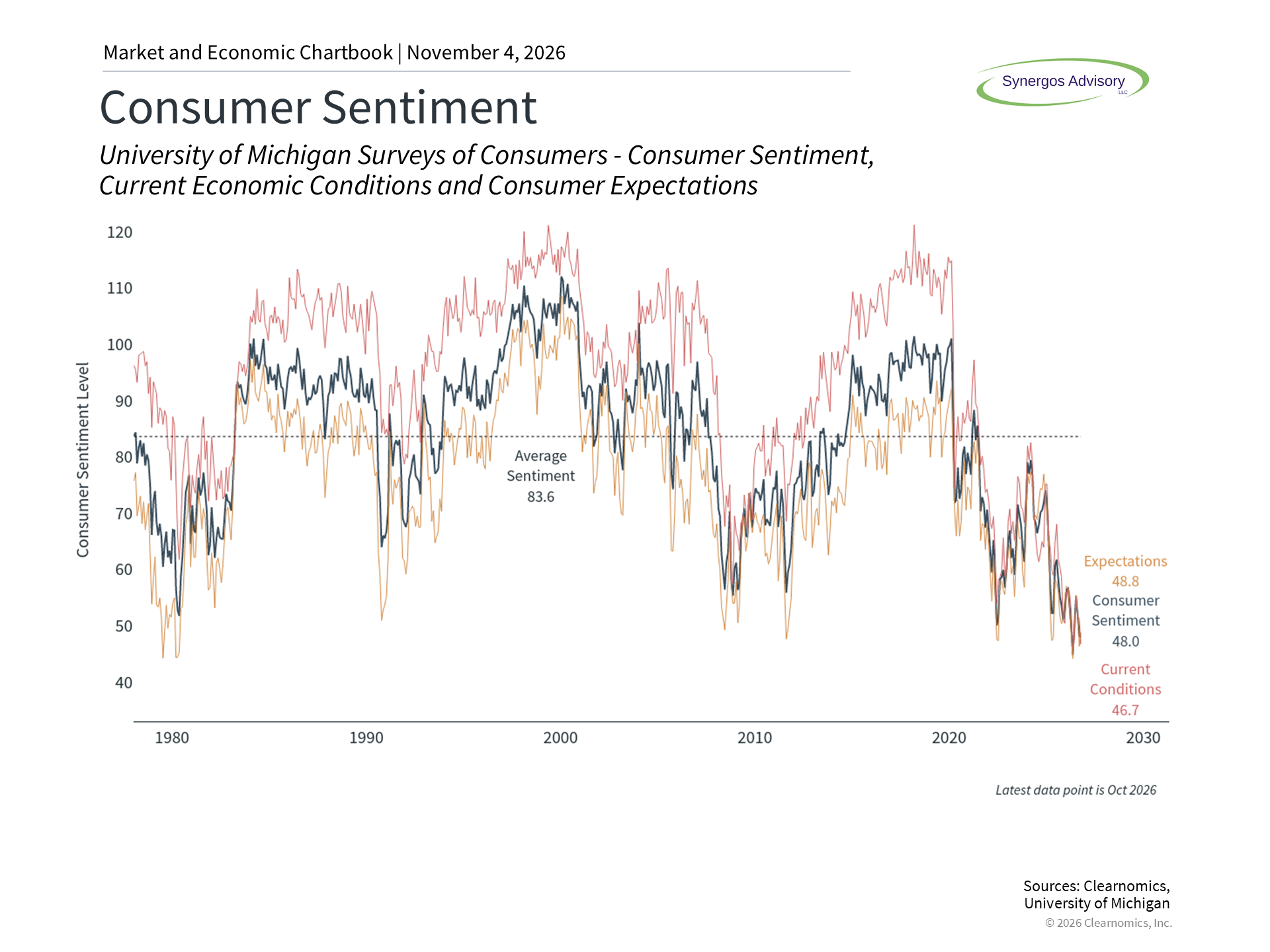 |
In 1992, political strategist James Carville summarized the key issue for voters with the tongue-in-cheek phrase, "it's the economy, stupid." This perspective is as important as ever, since concerns around inflation and jobs have driven consumer sentiment to historic lows. According to the AP's survey of voters, the economy was the single most important issue in this election, and nearly 90% said the cost of living was a crucial or major factor in their vote.1
The chart above shows that consumer sentiment has plummeted in recent years both in terms of how consumers feel about current conditions and their expectations for the future. In fact, October's reading of the University of Michigan index was the second lowest on record going back to 1952.2 This is primarily due to the rising prices that households have had to navigate since the pandemic, particularly around gasoline which is averaging $4.12 per gallon across the country, the 30-year mortgage rate around 7.3%, and Consumer Price Index (CPI) inflation of 3.7% in September.
At the same time, broad measures of consumer spending have remained healthy. The latest Gross Domestic Product (GDP) report for the third quarter shows that consumer spending grew 2.5% at a seasonally adjusted annual rate, which is historically strong and helped overall growth to exceed expectations.3
How can consumers feel pessimistic even as they continue to spend? One explanation is what economists refer to as the "K-shaped" economy, which describes a situation in which some households benefit from recent growth while others may not. For example, those with significant assets have benefited from rising markets, while those more exposed to the cost of fuel, food, and housing have felt the strain on household budgets more directly.
In other words, how consumers feel about the economy and how the overall economy performs are not always the same. On the one hand, consumer sentiment can drive voter behavior across the population, which explains these election results. On the other hand, portfolios tend to be driven by broader trends and the overall economy. So, it’s important to not overreact to sentiment or elections when it comes to investing and financial planning.
Policy uncertainty has affected markets
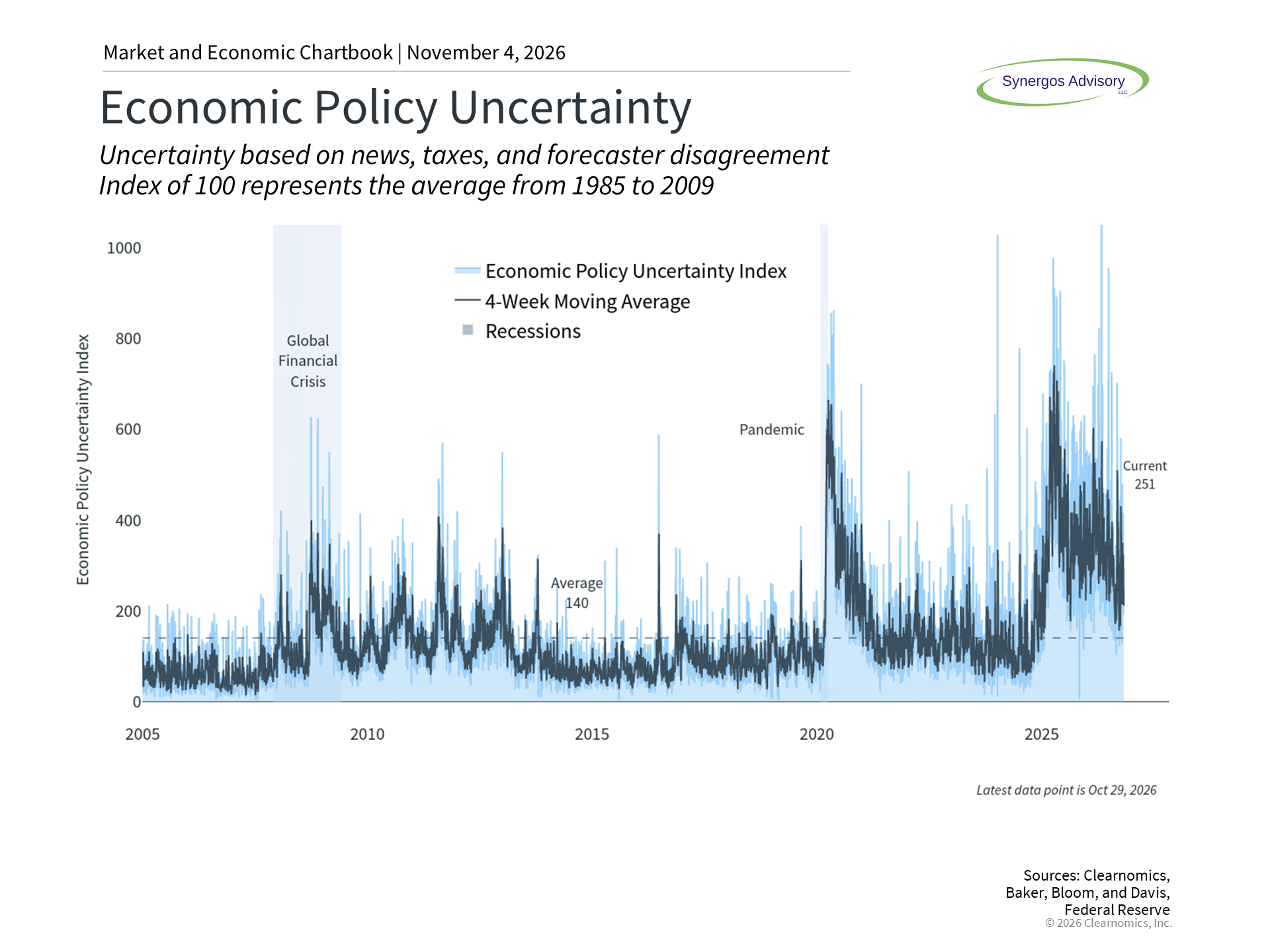 |
Policy uncertainty has been a contributing factor to short-term market swings in recent years, particularly around tariffs, the One Big Beautiful Bill Act, the rising national debt, and the war in Iran. The chart above shows that uncertainty spiked during last year's “Liberation Day” announcements, the debate over tax policy, and this year's Middle East conflict. In each case, markets experienced volatility before stabilizing as investors looked past the headlines and refocused on fundamentals.
One implication is that a divided government can mean fewer significant changes in policy, since major legislation often requires agreement and dealmaking across both parties. This can be interpreted as gridlock in Washington, but it can also potentially represent a more predictable environment for businesses and markets. Of course, one important exception is around the federal budget and the debt ceiling. With deadlines approaching in the coming months, it will be important to reach consensus to avoid a government shutdown.
Of the many specific policies that could affect certain industries, perhaps the most watched is the impact on data centers. The buildout of AI infrastructure has been a significant driver of economic growth, profits, and the stock market.
There were at least 41 local measures on the construction of data centers, and early results suggest that most of these favored new restrictions. Specifically, voters chose to limit data center development in 37 jurisdictions and to allow or support development in one, based in Harwood, North Dakota. One measure in Kansas banned "high-impact data centers," defined as facilities using more than ten megawatts of electricity or 100,000 gallons of water per day, for 10 years.4
The economy has grown under both political parties
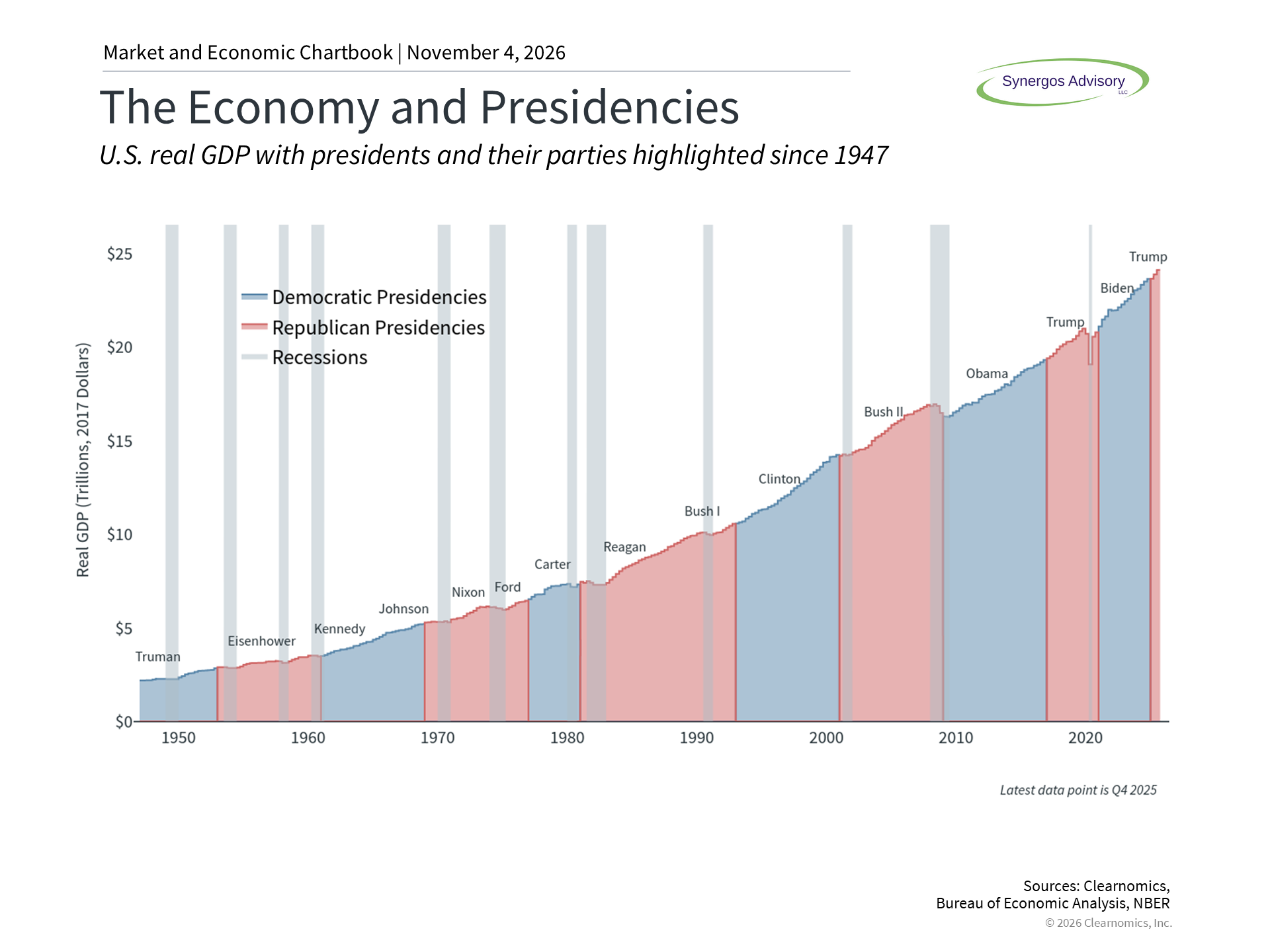 |
Ultimately, the most important perspective for long-term investors is that the economy has grown across many different political environments. The accompanying chart shows U.S. real GDP (which is adjusted for inflation) across each presidency going back to 1947, many of which included periods when the White House and Congress were controlled by different parties. In each case, the long-run trajectory of economic growth was driven by the business cycle and longer-term trends, not necessarily by politics.
None of this is to say that policy is irrelevant, or that changes to taxes, geopolitics, entitlement programs, and other areas don’t matter. Instead, history shows these issues are rarely the primary drivers of long-term portfolio outcomes. As citizens, voters, and taxpayers, elections are among the most important ways to make our voices heard. When it comes to investing, however, it is important to separate political views from financial decisions and not vote with our portfolios.
The bottom line? The midterm election results reflect voters' concerns about the economy and rising prices, but sentiment and political outcomes do not always translate directly to portfolio performance. Investors should continue to stay balanced and focused on long-term trends throughout political cycles.
References
1. https://apnews.com/article/midterms-trump-election-2026-democracy-economy-congress-young-voters-688773185f71690b00847726efbf045a
2. https://www.sca.isr.umich.edu/
3. https://www.bea.gov/data/gdp/gross-domestic-product
4. https://ballotpedia.org/El_Dorado,_Kansas,_Prohibit_Data_Centers_and_Battery_Energy_Storage_Systems_Initiative_(November_2026)
Synergos Advisory LLC doing business as Synergos Advisory is an Investment Adviser registered with the State of Washington. All views, expressions, and opinions included in this communication are subject to change. This communication is not intended as an offer or solicitation to buy, hold or sell any financial instrument or investment advisory services. Any information provided has been obtained from sources considered reliable, but we do not guarantee the accuracy or the completeness of any description of securities, markets or developments mentioned. We may, from time to time, have a position in the securities mentioned and may execute transactions that may not be consistent with this communication’s conclusions. Please contact us at 206-800-8056 if there is any change in your financial situation, needs, goals or objectives, or if you wish to initiate any restrictions on the management of the account or modify existing restrictions. Additionally, we recommend you compare any account reports from Synergos Advisory with the account statements from your Custodian. Please notify us if you do not receive statements from your Custodian on at least a quarterly basis. Our current disclosure brochure, Form ADV Part 2, is available for your review upon request, and on our website, www.synergosadvice.com. This disclosure brochure, or a summary of material changes made, is also provided to our clients on an annual basis.